
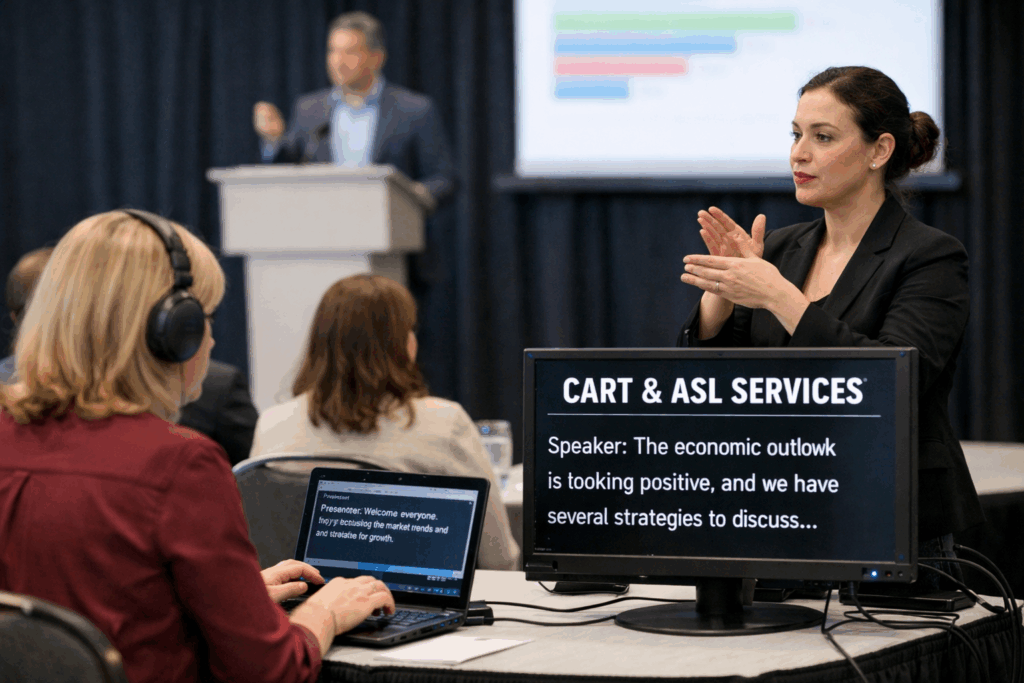
When people think about communication access, sign language interpreting is often the first solution that comes to mind. While interpreting is essential in many situations, it is not the only option available.
For individuals who rely on written English, Communication Access Realtime Translation (CART) can be the most effective form of access.
Understanding when to use CART — and how it works — can help organizations provide more inclusive and effective communication environments.
What Is CART?
CART is a live captioning service in which a trained captioner converts spoken communication into real-time text. Using specialized equipment and software, the captioner produces near-verbatim captions that appear on a screen, laptop, tablet, or personal device.
CART can be provided:
-
Onsite in the room
-
Remotely through a secure platform
-
Projected on a screen for group access
-
Delivered privately to an individual device
The goal of CART is to ensure participants can follow spoken communication as it happens.
When Is CART the Best Option?
CART is often the most appropriate communication access service when an individual:
-
prefers written English for clarity
-
is late-deafened or hard of hearing
-
wants a written record of the discussion
-
is in a lecture, meeting, or training with complex terminology
In these settings, captions can provide direct access to spoken information without requiring interpretation between languages.
CART Supports a Wide Range of Environments
Organizations frequently use CART services in:
-
college classrooms and academic lectures
-
workplace meetings and trainings
-
conferences and public presentations
-
legal proceedings and depositions
-
medical consultations and informational sessions
Because captions can be shared with multiple participants, CART can also improve access for large groups or hybrid events.
CART Benefits the Entire Audience
While CART is often requested to support individuals who are Deaf or hard of hearing, it is increasingly recognized as a tool that benefits everyone in the room.
Live captions can help audience members:
-
follow complex or technical discussions
-
stay engaged in long presentations
-
understand speakers with accents or fast pacing
-
take more accurate notes
-
participate effectively in hybrid or noisy environments
Because captions improve clarity and comprehension for many participants, organizations often find that CART enhances the overall communication experience — not just accessibility.
Planning Ahead Improves Access
As with any communication service, CART is most effective when planned in advance. Providing background materials, agendas, and terminology lists helps captioners prepare and deliver the highest level of accuracy.
Organizations that build CART into their communication planning process often find that it enhances participation, engagement, and understanding across their teams and audiences.
Access Means Offering the Right Tool
There is no single solution that works for everyone. Effective communication access comes from understanding individual needs and selecting the appropriate service — whether that is interpreting, CART, or a combination of both.
At The SOS Agency, we partner with organizations across healthcare, education, legal, and corporate settings to help determine the best communication access solutions for each situation. If you’re planning upcoming meetings, events, or trainings and want guidance on whether CART may be appropriate, our team is always happy to help.